

This article outlines the key steps involved in the graphic overlay manufacturing process.
Introduction
Graphic overlays are essential components in a wide range of products, devices and instrument, providing not only protection and durability but also enhancing the functionality and aesthetic appeal of user interfaces. From touch panels and membrane keyboards to control panels and display windows, these overlays are an integral part of many modern devices.
This article explores the key steps in graphic overlays manufacturing, offering valuable insights for design engineers, product managers, and purchasing managers. By understanding the manufacturing process, these professionals can make more informed decisions when sourcing custom graphic overlays that meet both functional and aesthetic requirements for your projects.
What Are Graphic Overlays?

A graphic overlay is a thin, often adhesive-backed layer of material, such as polyester or polycarbonate, applied to the top layer of a product or a device. It’s the top layer that the user sees when interacting with a device, control panel, or keypad. More than just a pretty face, it acts as a protective skin against wear and tear, environmental factors, and even harsh chemical exposure. Think of it as the durable, functional, and aesthetically pleasing faceplate of your product. They help visually enhance your product’s user interface.
Without a graphic overlay, the underlying components of your product may be vulnerable. The printed graphics, labels, and instructions could be easily scratched, faded, or damaged through regular use. A well-designed graphic overlay not only maintains the look and feel of your product over time, but also plays a critical role in usability by clearly communicating instructions, functions, and logo placement. It truly impacts the overall user experience, which is why many industries rely on custom overlays that are designed for a wide variety of purposes. Graphic overlays are thin yet very durable.
Why Should You Consider a Custom Graphic Overlay?
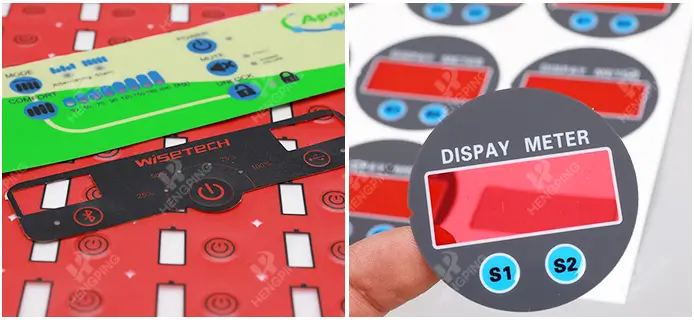
While standard overlays exist, custom graphic overlays offer unparalleled flexibility and customization for your product. Custom graphic overlays allow you to incorporate specific branding elements, match your desired color scheme, and create a unique user interface that resonates with your target audience. Imagine having a control panel with perfectly placed buttons, easy-to-read labels, and even a subtle texture or emboss to make it both visually appealing and intuitive to use. That’s the power of a custom graphic overlay.
A custom graphic overlay ensures that your product stands out from the competition. It’s not just about aesthetics; it’s also about creating an intuitive experience. The ability to customize the size, shape, and features of the overlay to fit your exact project’s needs is invaluable. Whether you need a specific adhesive, a dead front effect, or a backlight window, custom graphic overlay printing empowers you to realize your vision without compromise. When you design your graphic design you can make the user experience much easier.
How Graphic Overlays Are Manufactured?
The manufacturing process for graphic overlays requires a combination of design, materials science, and precision engineering. The primary manufacturing steps for graphic overlays typically include material selection, design and artwork paraparation, printing, embossing (or debossing), adhesive application, die cutting, quanlity inspection and packaging. These steps work together to produce high-quality, durable, and aesthetically pleasing overlays that can be used in a variety of applications. Here’s a detailed overview of the graphic overlay manufacturing process:
Material Selection
The selection of the right substrate material is crucial in the manufacturing of graphic overlays. The graphic overlay material must meet specific requirements based on the application, including durability, flexibility, clarity, and resistance to environmental factors. Commonly used materials include:

- Polycarbonate (PC)
Known for high impact resistance and clarity, ideal for durable applications requiring transparency. - Polyester (PET)
Offers excellent chemical resistance and dimensional stability, often used for applications requiring a thin, flexible overlay. - Acrylic (PMMA)
Provides good clarity and scratch resistance but lacks flexibility compared to polycarbonate. - Vinyl and PVC
Occasionally used for less demanding applications where flexibility and cost are prioritized, but are less environmentally friendly.
Design and Artwork Preparation
Before any production begins, the graphic design must be finalized. The design and pre-production stages are crucial for setting the foundation for a successful outcome. This stage involves working closely with the client or design team to create a layout that includes:
- Icons & logos & Text
The graphical elements must be created with high precision using vector graphics software (e.g., Adobe Illustrator, AutoCAD). - Tactile Feedback Areas
For membrane switches or keypads, areas requiring embossing or debossing need to be identified. - Cutout Areas
Design elements such as button holes, window openings, and display cutouts must be planned.
Once the design is ready, it is prepared as a digital artwork file, typically in vector format, for the next steps in the process.
Printing
The printing process is where the design, text, and graphics are transferred onto the chosen material. Graphic overlay printing is essential for ensuring that the final overlay is both visually attractive and durable.
- Screen Printing
It is a traditional method where ink is pushed through a mesh screen onto the substrate. This method works well for large areas of solid colors and text.
- Digital Printing
A more precise method that utilizes inkjet technology to print directly onto the substrate. Digital printing allows for high-resolution graphics, variable data, and faster turnarounds.
- Ink Selection
The type of ink chosen is based on several factors, including desired color vibrancy, resistance to environmental conditions, adhesion to the substrate, and overall durability. - Ink Curing
Inks require a curing process to be fully set and dried to the substrate. UV curing is a common method that uses ultraviolet light to quickly dry the ink while others may use heat or other methods.
Embossing and Debossing

In many cases, graphic overlays need to have raised (embossed) or depressed (debossed) areas to provide tactile feedback for users. This is particularly important for membrane switches and keypads.
- Embossing
It involves creating raised areas on the overlay to give buttons or symbols a tactile feel. This helps users identify buttons without needing to look at the overlay, which is especially valuable in industrial or automotive applications. - Debossing
It refers to creating recessed areas on the overlay, often used for branding or logos that are meant to stand out or give a 3D effect.
Embossing is achieved through the use of dies and press machines that apply pressure to the overlay material to form the desired shape.
Adhesive Backing
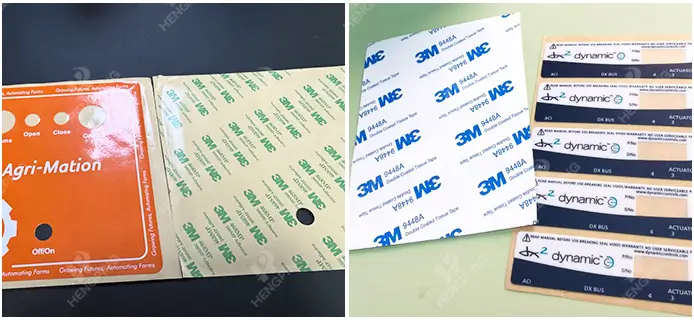
Once the graphic is printed and any embossing or debossing is completed, the next step is to apply the adhesive backing. This ensures that the graphic overlay can be securely attached to the device or control panel it is protecting.
- Adhesive Selection
The correct adhesive will need to be selected based on adhesion needs, environmental conditions, and required bond strength. Pressure-sensitive adhesive and acrylic-based adhesives are commonly used adhesive types, and 3M adhesives (such as 3M9448A, 3M467MP, and VHB series) are commonly used for graphic overlays in industries requiring high-performance adhesion. - Application Methods
The adhesive can be applied manually with precision tools for smaller production runs or automatically with automated equipment for higher production. - Lamination Process
Applying the adhesive can be a simple single layer process, or the adhesive can be applied to a carrier, which is then laminated to the back of the overlay. Multiple layers can be applied at this stage, which can include adding a structural layer, or a second layer of adhesive.
Die Cutting
Once the adhesive is applied, the overlay is ready for cutting to its final shape. This step is crucial to achieve precise dimensions and custom cutouts for things like buttons, displays, and indicator lights.

- Die-Cutting Methods
- Steel Rule Die-Cutting: A cost-effective method for medium to large production volumes using custom-made dies.
- Rotary Die-Cutting: Ideal for high-volume production and more intricate designs using rotary dies.
- Laser Die-Cutting: Ideal for precise cuts, complex shapes, and shorter production runs.
- Tolerance and Accuracy: The die-cutting process must maintain high accuracy and tight tolerances to ensure the final dimensions align with the overall design of the product and functional requirements.
- Waste Removal: The die-cutting process includes removing excess material, revealing the final product.
The cut pieces are then carefully inspected to ensure that the dimensions are accurate and that all cutouts (such as for buttons or displays) are properly aligned.
Final Inspection and Quality Control
After the cutting process, the graphic overlays undergo a thorough quality control process to ensure they meet the specified requirements. This typically includes:
- Visual Inspection: Ensuring there are no defects such as ink smudging, alignment issues, or imperfections in the embossing/debossing.
- Adhesion Testing: Verifying that the adhesive used has the necessary strength and is free from any peeling or lifting.
- Functional Testing: For membrane switches and keypads, functional tests are carried out to ensure that all switches work as intended and that the tactile feel is appropriate.
- Environmental Testing: If required, overlays are subjected to tests that simulate real-world environmental conditions (such as extreme temperatures, humidity, and chemical exposure) to verify durability.
Assembly and Packaging
The final graphic overlays are then ready for assembly with other components, such as membrane switches, displays, or control panels, depending on the product. Once assembled, they are packaged securely to prevent damage during shipping and handling.
Top 8 FAQs About Graphic Overlays Manufacturing
As clients often have specific questions regarding the production of graphic overlays, we’ve compiled a list of frequently asked questions to help clarify common concerns.
Screen Printed vs Digitally Printed, Which Printing Method is Best for Your Overlay Projects?
For many graphic overlays manufacturing factories, the most commonly used printing method are screen printing and digital printing.

- Screen Printing: Better for solid colors, large areas, higher durability, more cost-effective for large volumes.
- Digital Printing: Better for high-resolution images, fine details, gradients, shorter runs, customization. Digitally printed graphics are ideal for short runs or when rapid prototyping is needed.

The choice between screen and digital printing is often dictated by the complexity of the design, required volume, cost constraints and the desired durability and visual effects. If you are not sure which one is best for your project, just ask your supplier, then their professionals will offer detailed analysis or real project case for your references.
What Overlay Materials Are Available And What Are Their Specific Benefits?
As before mentioned, the most commonly used materials for graphic overlays are polycarbonate, polyester, and acrylic.
- Polycarbonate (PC)
PC is a popular choice for control panel applications and harsh environments where durability is a primary concern. It will ensure your device will have a long-lasting graphic overlay. - Polyester (PET)
PET is often selected for membrane switch applications where flexibility is critical. - Acrylic (PMMA)
PMMA is more suitable for indoor applications where physical impact is less likely. Common applications include consumer electronics, medical devices, and point-of-sale displays.
The choice of graphic overlay materials should depend on the specific demands of the application. Understanding the pros and cons of each material is essential to determine the best fit for your product and your manufacturing needs. Some applications also benefit from a hard coat to increase abrasion and chemical resistance.
Do Graphic Overlays Come with Adhesive Backing?
Yes, most graphic overlays come with a pressure-sensitive adhesive backing for easy application. Graphic overlays manufacturers also offer a variety of adhesive options depending on the application. Adhesive brands, such as 3M, Tesa, Nitton, are often requested.
What Is a Dead Front Graphic Overlay?
A dead front is a graphic overlay that only becomes visible when illuminated from behind. This feature offers a clean, modern look and is often used for hidden displays or indicators. (Related Product: Acrylic Panels with Dead Front Printing Window >>)
What Design Options Are Available When Creating Graphic Overlays?
The design possibilities for graphic overlays are vast, offering a range of colors, finishes, and textures. Embossing can enhance tactile feedback, helping users locate and operate controls, while transparent or dead-front sections can accommodate displays and indicators.
Additionally, graphic overlays can be customized to fit your product’s shape and size, incorporating logos and textures to elevate the user experience. This flexibility in design provides a competitive edge and allows for strong brand alignment with your product’s functionality and overall strategy.
How Does the Overlay Manufacturing Process Ensure High-Quality Results?
The overlay manufacturing process involves a combination of precision techniques and quality controls. From material selection to printing and finishing, every step is carefully managed to ensure high-quality results. A reliable graphic overlay manufacturer will use top-of-the-line equipment and maintain strict quality control measures.
Experienced manufacturing teams understand the subtleties of working with different materials, inks, and adhesives. They also ensure the final graphic overlays meet the specific needs of your project’s application, whether it requires resistance to chemicals, extreme temperature, or abrasion. Manufacturing graphic overlays is a task that requires specialized knowledge and proper processes to ensure you receive a high-quality graphic product.
Where Can You Find a Reliable Graphic Overlay Manufacturer?
Finding a trusted graphic overlay manufacturer is vital to the success of your project. Look for a company with a proven track record, decades of experience, and a commitment to quality. A good graphic overlay manufacturer will offer a wide range of material options, printing techniques, and finishing services to meet your specific requirements. They also need to be able to provide custom and long-lasting solutions.
A reputable overlay manufacturer should also have a robust supply chain and the capacity to handle both large-volume and short-run projects. Graphic overlay manufacturers in China boast cost-effective production, advanced technology, and ability to deliver high-quality, customized solutions at scale, making them ideal partners for both large and small businesses. (Read more: Top 10 Graphic Overlays Manufacturers in the UK >>)
Summary
The graphic overlays manufacturing process involves a combination of design, material selection, printing, and finishing techniques, all of which must be executed with precision to achieve high-quality results. By partnering with a reliable manufacturer, like Hengping Industry, you gain access to expert knowledge in every stage of the process, from conceptualization to the final product.

With decades of experience in custom graphic overlays, we ensure that each project meets your specific functional, aesthetic, and branding requirements. Whether you need overlays for control panels, keypads, or other applications, we deliver tailored solutions with competitive pricing and exceptional quality. Contact us today to start your project and experience the difference that expertise and attention to detail can make in your graphic overlays manufacturing process.


 English
  French
  German
  Spanish
  Portuguese
  Italian
  Dutch
Dutch  Turkish
  Russian
  Arabic
  Japanese
  Korean
  Vietnamese
  Thai
Thai  Indonesian