 Skip to main content Skip to footer


From mobile phone screens to coffee machine operation panels, from agricultural sensors to smart home devices, graphic overlays are everywhere in our life. As an important interface technology, graphic overlays play an indispensable role in modern society.
With the rapid growth of the Internet of Things, smart manufacturing and consumer electronics, the demand for graphic overlay is growing. If you are looking for a suitable customized graphic overlay solution for your project or product, the followings provide you with valuable reference.
What is Graphic Overlays?
Graphic overlays, also known as front control panels, front labels and stickers, nameplates, or faceplates, are essential components for modern products. They serve as the visual interface between users and devices, acting as the face of electronics and equipment. It is a thin, specially designed, and custom-printed outer layer and is applied to surfaces like control panels, buttons, and displays, providing a visual guide for users.

Graphic overlays are commonly made from durable materials, such as plastics, and printed or etched with specific graphics, text, and finishes to match the product and the brand. Graphic overlays not only enhance the product’s appearance with a professional finish, but also protect the underlying surface from daily wear and tear. More importantly, graphic overlays clearly label buttons, display instructions, and provide essential information, making complex technology more approachable and user-friendly.
What Types of Graphic Overlays are Available on the Market?
Graphic overlays can be categorized into different types based on different criteria. It is generally categorized on the basis of functions or materials in the market place.
Graphic Overlay Types by Functions
Below introduces the main types of graphic overlay classified by the functions of graphic overlays.
Membrane Switch Overlays
Membrane switch overlays, also known as membrane keyboards, are the most common type of graphic overlays. Membrane switches integrate printed circuits that control electronic devices by touching the keypad area on the membrane overlay panel to close the circuit.

Membrane switch overlays are characterized by being thin, lightweight, well sealed and low cost, and widely used in consumer electronics, medical equipment, industrial automation and other industries. Commonly examples of membrane switch overlays are remote controls, microwave oven control panels, front control panels of medical instrument and more.
Tactile Overlays
Tactile overlays are membrane switch panels with raised/embossed buttons or textures that provide more pronounced tactile feedback to enhance the user experience, such as control panels for industrial equipment, center console buttons in automotive and more.
Backlit Overlays
Backlit overlays provide clear key identification and instructions in low-light environments by displaying built-in LEDs or other light sources, like utomotive dashboards, nighttime operating panels for medical equipment and more.
Deadfront Overlays
Deadfront overlays mean that the pattern and text on the surface of overlay panel are hidden by default, and will only be displayed when a specific button is activated or the device is powered on. The design of deadfront overlays enhance the sense of technology and aesthetic design of products, such as high-end audio equipment, smart home control panels and more.
Static Overlays
Static overlays are mainly decorative and do not have circuit function, they are used to enhance the appearance of the product, identify the brand and product information, such as brand logos on household appliances, product model number identification, safety warning signs, etc.
Graphic Overlay Types by Materials
Materials are extremely important for the function and durability of graphich overlays, so graphich overlays can be classified by materials sometimes. Below introduces the main types of graphic overlay classified by materials.
Polycarbonate Graphic Overlays – PC Graphic Overlay
Polycarbonate graphic overlays, also called PC graphic overlays, are the most common types of graphic overlays. Due to the superior durability, extreme strength and impact resistance of polycarbonate, polycarbonate graphic overlays are the ideal front control panels for demanding environments, such as, industrial equipment, medical devices and more.

Additionally, polycarbonate graphic overlays are also excellent for applications require backlighting or displays. The most famous and reliable polycarbonate is Lexan, so polycarbonate graphich overlays are also called lexan overlays, or lexan labels or stickers.
Polyester Graphic Overlays – PET Graphic Overlay
Polyester graphic overlays, another common types of graphic overlays, is affordable, while still offering good chemical and weathering resistance for indoor applications. PET graphic overlays are great choices for products or equipment in which appearance and clarity of markings are important.

PVC Graphich Overlays
PVC graphic overlays usually require low cost. PVC graphic overlays are suitable for cost-sensitive products that are used in relatively mild environments since its its heat resistance and durability are not as good as polycarbonate graphic overlays or polyester graphic overlays.
Acylic Front Panels
Acrylic front panels are the common name of graphich overlays made of acrylic. Acrylic, also known as PMMA, is a highly transparent plastic material that is often used to create beautiful, crystal clear graphic overlays, such as, indoor signage, display panels, and panels for household appliances.
Glass Panels
Glass panels, also known as cover lens or cover glass, can be printed with patterns, text or symbols, and now are widely used as the overlay panels for electronic products, household appliances, medical equipment, outdoor instruments, industrial equipment and more.
Choosing the Right Graphic Overlay Material for Your Project
As just mentioned, the materials used for graphic overlays manufacturing are varied and each has different properties and features. The following is a brief description of the properties of each graphic material.

Polycarbonate/PC/Lexan
As the most popular material for graphic overlay, polycarbonate, also known as PC or Lexan, is favorited for its outstanding durability and versatility.
Advantages of Polycarbonate Material
- Excellent Impact Resistance: Polycarbonate has very high impact strength, can withstand knocks and drops, and maintains good mechanical properties even at low temperatures.
- High Heat Resistance: Polycarbonate can withstand temperatures up to 130°C without deformation.
- Good Electrical Insulation: Polycarbonate has excellent performance in electrical and electronic applications.
- Chemical Resistance: Polycarbonate is resistant to a wide range of chemicals, so polycarbonate graphic overlay is suitable for equipment that requires exposure to chemicals.
- High Optical Transparency: Polycarbonte can be manufactured as a transparent material for applications that require light transmission, backlighting or displays.
- Ease of Processing: PC can be easily processed into a variety of shapes, suitable for the manufacture of complex components.
Disdvantages of Polycarbonate Material
- High Cost: Compared to other plastic materials of graphic overlays, polycarbonate is more expensive.
- Easy to Scratch: Polycarbonate is easy to scratch, but can be improved by surface treatment. Polycarbonate graphic overlays without special surface treatment is easy to scratch.
- UV Sensitive: When long-time exposed to UV light, polycarbonate may be yellowed and degraded.
Typical Applications of Polycarbonate Graphic Overlays
The typical applications of polycarbonate graphic overlays are industrial control panels, medical equipment, outdoor signage or labels, automotive dashboards, etc.
Polyester/PET
Polyester, also called PET, is also the most commonly used material for the manufacturing of graphic overlays due to its excellent properites.
Advantages of Polyester Material
- Recyclability: PET material can be recycled effectively.
- Good Tensile Strength: PET has good mechanical strength and rigidity.
- Excellent Abrasion Resistance: PET has excellent performance in terms of friction and wear.
- Good Chemical Stability: PET is highly resistant to most acids, alkalis, solvents and more.
- Low Water Absorption: PET material has low water absorption and is not sensitive to changes in humidity.
- Higher Heat Resistance: PET can withstand temperatures up to 150°C without deformation.
- Cost-effective: PET is relatively inexpensive for cost-sensitive applications.
- Good Printing Results: High quality printing results can be achieved with vibrant, long lasting colors on PET graphic overlays.
Disadvantages of Polyester Material
- Inability to Maintain High Transparency over Time: Compared to PC, PET is less transparent and may become cloudy at high temperatures over time.
- Narrow Processing Temperature: The narrow temperature window for processing PET limits the way it can be processed.
Typical Applications of Polyester(PET) Graphic Overlays
The typical applications of polyester graphic overlays has household appliance panels, membrane keyboards, nameplates, labels, etc.
PVC
PVC is polyvinyl chloride. PVC is at low price and the most widely used graphic overlay material in the past. Now, PVC is gradually replaced by PC and PET for graphic overlay manufacturing since most of its performance is not as good as PC and PET except for its low price.
Advantages of PVC Material
- Weatherability: Weather-resistant PVC has significantly better outdoor weathering properties than that of PET.
- Low Cost: PVC is the cheapest of all materials for graphic overlays and is suitable for extremely price-sensitive applications.
- Easy to Process: PVC is easy to cut, print and mold with low processing costs.
Disadvantages of PVC Material
- Poor Environmental Friendliness: Halogens are used in the production of PVC, which ultimately produce harmful substances such as dioxins, vinyl chloride monomer and more. These substances are potentially harmful to human health and the environment. Therefore, some environmental organizations have called for reducing or replacing the use of PVC products in recent years.
- Poor Thermal Stability: The heat resistance of PVC is not as good as that of PET and PC. Common PVC is probably resistant to 80℃ to 100℃, polymer PVC is resistant to as high as 120℃ to 140℃. PVC is easy to decompose at high temperatures and then produces harmful gases, which limits the application of PVC in some high temperature areas.
Typical Applications of PVC Graphic Overlays
PVC can be used for short-term overlay labels and stickers, indoor signs, etc.
Acrylic/PMMA
Acrylic, also known as PMMA, is a highly transparent plastic material that is often used in graphic overlays where clear images and vibrant colors need to be displayed.

Advantages of Acrylic Material
- High light Transmission: With a light transmission rate of 92%, acrylic is more light transmitting than glass, making it suitable for applications that require a high degree of transparency.
- Vibrant Color: Highly saturated color printing is possible for acrylic, resulting in more vibrant and brighter graphics.
- Weather Resistant: Acrylic is not easily affected by UV rays and climate change, suitable for outdoor applications.
Disadvantages of Acrylic Material
- Poor Scratch Resistance: Acrylic is susceptible to scratches, affecting appearance and service life.
- Moderate Impact Resistance: Acrylic is not suitable for applications requiring strong impacts.
Typical Applications of Acrylic Front Panel
Acylic front panels are widely used for home apppliances, medical devices, audio equipment and more.
Tempered Glass
Tempered glass is a specially treated glass that is extremely strong and scratch-resistant and is commonly used in graphic overlays where durability and safety are critical.
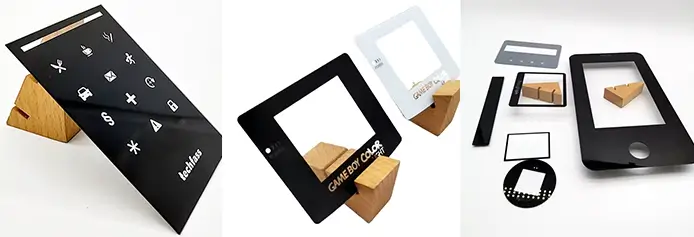
Advantages of Tempered Glass Material
- High Strength: The impact strength of tempered glass is 4-5 times stronger than ordinary glass, not easy to break.
- Scratch Resistant: High surface hardness, not easy to appear scratches, durable.
- High Temperature Resistance: Tempered glass can withstand high temperatures, suitable for applications requiring heat resistance.
- Easy to Clean: Tempered glass has smooth surface, so it is not easy to stain, easy to clean.
- Stylish and Modern Design: Tempered glass enhances the aesthetics of the product.
Disdvantages of Tempered Glass Material
- Costly: Tempered glass is the most expensive of all materials for graphic overlays, so it is suitable for high-end products.
- Heavy: Tempered glass panel is heavier than other materials, not suitable for weight-sensitive applications.
- Not Easy to Process: Tempered glass is difficult and costly to process.
Typical Applications of Tempered Glass Panel
Tempered glass panel is ideal choice for high-end electronic product screens, touch panels, medical device panels, etc.
What are the Benefits of Graphic Overlays?
Graphic overlays have become an integral part of modern product design, contributing significantly to enhancing product value and user experience. So, what are the benefits of graphic overlays?
Customizable
One of the great strengths of Graphic overlays is their powerful customization capabilities. Whether it’s color, size, shape, material or functionality, it can be personalized to meet your specific needs. This allows graphic overlays to fit perfectly into a variety of product designs, enhancing product aesthetics and brand recognition.

Cost-effective: Reduced Production Costs
Graphic overlays are more cost-effective than traditional mechanical pushbuttons and panels because they are relatively simple to produce and have a short cycle time, which effectively reduces production costs. In addition, graphic overlays are usually installed with adhesive backing, which is easy to operate and requires no special tools, saving installation time and costs. Moreover, its wear-resistant, corrosion-resistant and aging-resistant characteristics greatly extend its service life and reduce maintenance costs.
Wide Range of Applications
Graphic overlays are used in a wide range of industries due to their excellent performance and flexible design.
What is Appplication Fields of Graphic Overlay?
As before mentioned, graphic overlays has been widely used in various industries due to its superior advantages.

Consumer Electronics
- Home Appliances: Control panels for various home appliances such as microwave ovens, ovens, dishwashers, washing machines, coffee makers, air conditioners and more.
- Entertainment Devices: Control panels and logos for entertainment devices such as TVs, stereos, game consoles, remote controls, etc.
- Personal Electronics: Buttons and decorative panels for personal electronics such as cell phones, tablet PCs, e-readers, smart watches, etc.
Industrial Controls
- Industrial Automation Equipment: Control panels of production line, operation panels of machine, instrument panels, etc.
- Instrumentation: Operation panels and displays for measuring instruments, testing instruments, analyzing instruments and other instruments.
- Security Equipment: Alarm systems, monitoring systems, access control systems and other security equipment operating panels and indicators.
Medical Equipment
- Medical Devices: Operation panels and displays of medical devices such as electrocardiographs, ultrasound machines, blood analyzers and so on.
- Medical Devices: Markings and scales of medical devices such as syringes, infusion sets, blood pressure monitors, etc.
- Laboratory Equipment: Operation panels and signs for laboratory equipment such as laboratory instruments, analyzers, testing instruments, etc.
Automotive Transportation
- Automotive Interior: Automotive instrument panel, center console, door control panel, steering wheel buttons, etc.
- Motorcycle: Motorcycle dashboard, control buttons, etc.
- Other Transportation: Operation panels and signs of airplanes, ships, trains and other transportation.
Other Fields
- Retail: Cash registers, self-service terminals, electronic price tags, etc.
- Financial Industry: ATM machines, self-service banking equipment, etc.
- Public Facilities: Vending machines, information inquiry machines, queuing machines, etc.
How Graphic Overlays are Manufactured?
The manufacturing process for graphic overlays may seem simple, but each step is critical and requires precise control and strict quality management to produce a final, high-quality graphic overlay products. Below is the main process of graphic overlay manufacturing:
Requirements Validation
The first and foremost task at this stage is to fully communicate with the client to clarify key information such as functional needs, design requirements, size specifications, material choices and color standards of the graphic overlay. Subsequently, the designer will use professional software to draw a detailed design based on this information, and finally confirm all the details with the client to ensure that the final design solution meets the expectations.
Film Output
The finalized design is output as a high-precision film, which contains all the pattern and text information of the graphic overlay and is used for the subsequent exposure process.
Printing
The printing stage begins with the production of the appropriate screen printing plate based on the film, and the blending of inks that meet the color criteria according to the customer’s requirements and the design. Afterwards, the design and text are printed onto the substrate layer by layer using screen printing technology, which usually requires several printings to complete the overlay of all colors. Finally, the ink needs to be thoroughly dried after printing before moving on to the next process.
Surface Treatment
Depending on the requirements, a protective coating can optionally be applied to the graphic overlay surface to enhance its abrasion resistance, chemical resistance and UV resistance. It can also be hardened to increase the surface hardness. It can also be embossed or textured to add tactile feedback or enhance aesthetic appeal.
Die Cutting
A precision die-cutting mold is created based on the designed size and shape of the graphic overlay. The die is then used to cut the printed graphic overlay to precisely match the final shape and size.
Adhesive Backing
Select the appropriate type of adhesive backing, such as 3M or tesa backing, according to the application scenario of the graphic overlay and the need for adhesion. Then, the selected adhesive backing is evenly applied to the back of the graphic overlay to ensure that the adhesive is firm and does not come off easily.
Quality Inspection and Packaging
The finished products are subjected to strict quality inspection to ensure that their appearance, dimensions and functionality meet the standards. All the tested graphic overlay will be carefully packed for transportation and storage, and finally delivered to customers.

What is the Considerations to Custom-made Graphic Overlays?
If you are going to get graphic overlays for the products of your projects, how to get the most suitable custom-made graphic overlasy? There are two aspects you can take into considration.
Environmental Considerations
- Indoor and Outdoor Use: Graphic Overlay for outdoor use needs to be resistant to environmental factors, such as, UV rays, extreme temperatures, and humidity.
- Chemical Corrosion and Abrasion: Chemicals and cleaning agents commonly found in industrial environments can damage graphic overlay, so chemical-resistant materials are required.
- Sterile Environments: Sterile environments, such as medical, require materials with antimicrobial properties and resistance to aggressive cleaning agents.
- Ambient Light: Bright light can cause glare and affect the readability of Graphic Overlay. Choosing the right surface treatment, such as an anti-glare treatment, can be an effective solution to this problem.
- Frequent Use and Mishandling: For scenarios where the Graphic Overlay is frequently used or may be subject to mishandling, such as kiosks in public places, more durable materials, such as thicker metal, glass, etc., are required.
Aesthetic Considerations
- Surface Finishing: Various surface finishes such as glossy, matte, textured, brushed, patterned, etc. can be selected to achieve different visual effects.
- Printing Effects: In addition to screen printing, digital printing can also be used to achieve special effects such as gradient, photo-quality images, and customized spot colors.
- Color Options: A wide variety of color options are available, including metallic and transparent colors, which can simulate textures such as brushed metal.
- Backlight and Display: Graphic Overlay is usually made of transparent material, which can be easily integrated with backlight and display components, such as LCD, LED, EL, etc., to enhance the technological sense of the product.
- Embossing: The embossing process allows for the creation of raised keys and patterns to enhance tactile feedback and decorative effects.
Choosing the right graphic overlay solution requires a combination of environmental and aesthetic considerations in order to maximize the functionality and design aesthetics of the product.
What Determines the Cost of Graphic Overlay?
There are a number of factors that affect the cost of graphic overlay, each project is customized and the final price depends on a combination of factors.

Firstly, the choice of material is one of the main factors that affects the cost. Just like choosing different fabrics for clothing, Graphic Overlay materials come in different grades and prices. For example, durable polycarbonate is usually more expensive than standard polyester.
Secondly, the degree of customization also affects the cost. Simple off-the-shelf Graphic Overlay is less expensive, while complex processes such as custom colors, special shapes, embossing, or special surface treatments add to the cost.
In addition, the application scenario is also a determining factor. Graphic Overlay used in harsh industrial environments requires more durable materials and special treatments, and therefore costs more. Finally, functional features also affect price. Features such as backlighting, tactile feedback embossing, or antimicrobial enhance the performance of Graphic Overlay, but also increase the cost.
The cost of graphic overlay is like customizing a car versus buying a standard model – the more features, the more complex the process, and the more advanced the materials, the higher the price.
Conclusion
In today’s user-experience-oriented era, graphic overlays have become the finishing touch of modern products. If you ever need to work with a graphic overlay manufacturer that you can trust, get it with us here at Hengping Industry.
For more almost 10 years in the label printing industry, we’ve proven our skills, expertise, and experience through dedication, hard work, and premium quality label projects. Our experience brought us to work with countless names in the industry, and we’re more than happy to be part of their journey.
- We have worked with 50+ countries across all continents;
- We have professional teams of engineers and printing experts;
Whether you’re looking for graphic overlays, control panel labels and stickers, or if you need whatever label printing done, you can count on us and our team of experts to complete it for you. Don’t worry about pricing, we’ll take care of you. We treat all our clients’ businesses as ours, and we’ll do the same for you. Contact us and we’ll be more than happy to help you by giving you a free quote.



 English
 French
 German
 Spanish
 Portuguese
 Italian
 Dutch
 Turkish
 Russian
 Arabic
 Japanese
 Korean
 Vietnamese
 Thai
 Indonesian
