
This article discusses adhesive backing, one of the most important process of graphic overlays design and manufacturing, and provides guide to help you make informed decisions and achieve flawless adhesion. Now, let’s explore the sticky science behind successful graphic overlays projects.
Introduction
Graphic Overlays are widely used across multiple sectors, including consumer electronics, industrial equipment, medical devices, automotive, aerospace, retail, self-service machines and more. Whether it’s the control panel of a microwave oven or the buttons on an industrial control console, graphic overlays provide clear operational instructions, protect devices from wear and tear, and enhance the visual appeal of the product. (Read more: 3 Key Elements in Graphic Overlays Design: Text, Color and Pattern >>)
The successful application of graphic overlays depends on a critical element: adhesive backing. In the following sections, we will explain the importance of the adhesive backing in the design and manufacturing of graphic overlays. We will also explore how to choose the right type of adhesive to meet the specific needs of different application environments.
Why Backing Adhesive is Indispensable for Graphic Overlays?
Graphic overlays are more than just pretty faces for equipment or devices. They’re users’ interfaces, brand identifiers, and protective layers all rolled into one. But without a good adhesive, they’re nothing more than flimsy stickers. Check the indispensable role of backing adhesives for graphic overlays.
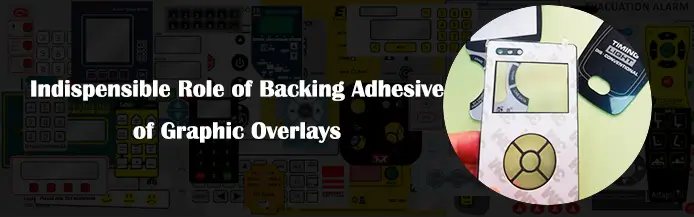
- Firstly, secure attachment is the most obvious benefit. The adhesive’s fundamental job is to keep the graphic overlay firmly attached to the product’s surface. This ensures the overlay remains in the correct position, preventing it from shifting, peeling, or even falling off. This is not only about aesthetics; it’s also critical for functionality. Imagine pressing a button on your microwave only to have the overlay slip, misreading the command – that is an issue that the adhesive solves!
- Secondly, backing adhesives provide environmental protection. The adhesive acts as a barrier, safeguarding the underside of the graphic overlay from various contaminants like moisture, dust, and oils. It also protects from physical damage and corrosion. This layer of protection enhances the overlay’s longevity and maintains its visual appeal and integrity over time. This is especially important for products used in harsh environments.
- Thirdly, adhesives help with ease of manufacturing and assembly. Pre-applied adhesives simplify the manufacturing process by eliminating the need for manual adhesive application. This reduces the risk of errors and inconsistencies, speeds up production time, and lowers manufacturing costs. It ensures consistent and repeatable results in mass production, reducing scrap and waste.
- Finally, a good backing adhesive contributes to the overall durability and performance of the product. By forming a robust and resilient bond, the adhesive enables the overlay to withstand daily wear and tear, temperature changes, and even exposure to chemicals. This ensures the product remains functional and visually appealing throughout its intended lifespan. This reliability is a key factor in the overall value of the product.
Why Choose 3M Adhesive Tape for Graphic Overlays?
When it comes to adhesive tapes for graphic overlays, 3M Adhesive Tapes is a name that often comes up and for good reason. 3M isn’t just another brand; it’s a leader in adhesive technology, with a reputation for quality and reliability. But what makes 3M adhesive tapes so popular for graphic overlays?
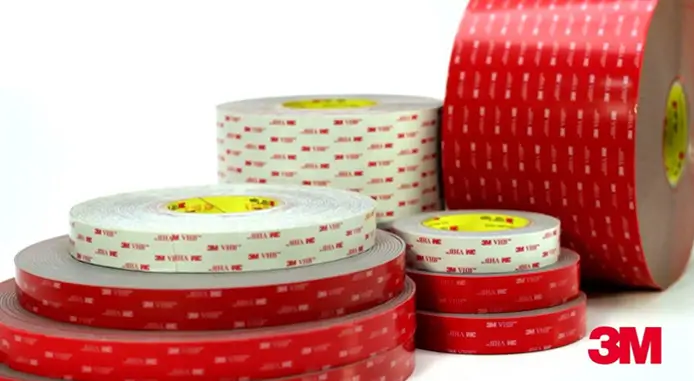
- Firstly, 3M offers consistent high quality. Their manufacturing process is closely monitored, and their adhesives are known for having consistent and repeatable performance. This is really important because it means you’re not going to get batches of adhesive with wildly differing characteristics. This is key to ensuring a high and consistent level of product performance over time. If you’re using 3M, you know what you’re going to get.
- Secondly, 3M has a wide range of options. They offer a variety of adhesive tapes tailored to different materials, substrates, and environmental conditions. Whether you need a high-tack adhesive for low-surface-energy plastics or a high-temperature resistant adhesive for industrial applications, 3M likely has an option that fits the bill. This means that you are far more likely to be able to find a 3M product that fits your needs than with a lesser manufacturer with fewer options.
- Finally, 3M is innovative. They’re constantly researching and developing new adhesive technologies to meet the ever-changing needs of the industry. This commitment to innovation means that you’re often getting the latest and most reliable technology when you choose 3M. This translates to a better end product and fewer issues down the line. 3M also provides a wide range of documentation and support for all of their products. This makes choosing the right adhesive, and using it correctly, a far easier task, even for newcomers to the industry.
What Are the Most Popular 3M Adhesive Tapes for Graphic Overlays?
Now, let’s get into the nitty-gritty and explore some of the most popular 3M adhesive tapes used for graphic overlays. Knowing these will help you understand the different options and how they might best serve your needs. Here is a selection of the most common choices.
Quick Overview
| 3M Tape | Type | Relative Temp Resistance | Relative Adhesion Strength | Water Resistance |
| 467MP | Transfer Adhesive | Good | High | Good |
| 468MP | Transfer Adhesive | High | High | Good |
| 9495LE | Double-Sided Tape | Moderate | High | Moderate |
| 300LSE Series | Double-Sided Tape | Moderate | High | Moderate |
| 9080A | Double-Sided Tape | Moderate | Moderate | Low |
| 7945MP | Transfer Adhesive | Very High | High | Good |
| VHB Series | Foam Tape | Moderate – High | Very High | Good |
Detailed Features
- 3M 467MP & 3M 468MP
These are transfer adhesives, which means they don’t have a carrier film. They are very thin and provide excellent adhesion to a wide range of surfaces. They are often chosen for their great chemical resistance and dimensional stability. These are a common choice, for general purpose usage.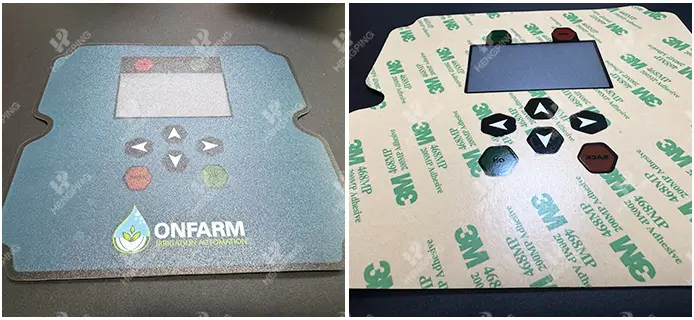
3M 468MP adhesive backing for graphic overlays - 3M 9495LE
This is another popular double-sided tape known for its strong adhesive and good peel strength. This is considered a “go to” tape for most general applications. - 3M 9080A
A thick double-sided tape often used for uneven surfaces as the thicker tape fills in any imperfections. It offers good tack, adhesion, and is useful where there might be more variation in the substrate. - 3M 300LSE series (like 3M 9495LE 300LSE)
These are specifically designed for low surface energy plastics. They are essential for bonding to plastics like polyethylene and polypropylene that are notoriously hard to stick to. It has a much higher peel strength and will create a more reliable and robust bond in those situations.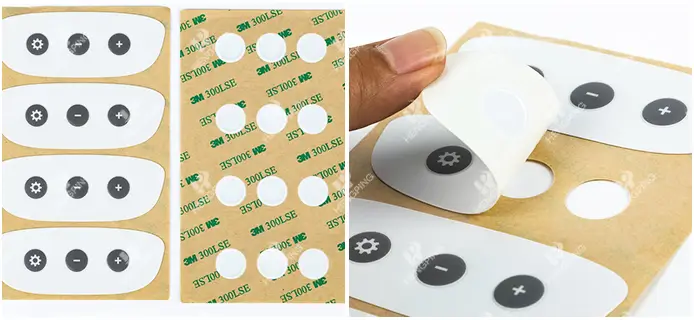
3M 300LSE backing adhesive for graphic overlays - 3M 7945MP
Specifically designed for high-temperature environments. This is perfect for applications where the overlay is likely to be exposed to heat. - 3M VHB Series (Very High Bond)
These are foam tapes that offer very high bond strength and are often used in demanding applications where high loads are present, or to bond to rougher and uneven surfaces.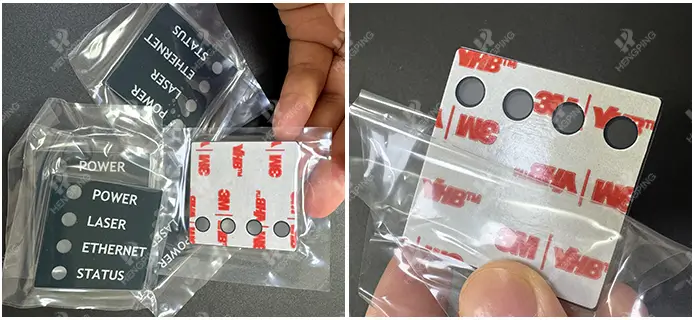
3M VHB adhesive tape for graphic overlays
It’s important to note that these are some of the most popular, but 3M offers a much wider range. Always consult the 3M datasheet for the specific product you are interested in to ensure it meets your requirements.
How to Choose the Right Adhesive Tape for Your Specific Application?
Choosing the correct adhesive tape for your graphic overlay is not a simple matter. It requires careful consideration of several factors to ensure that you get a bond that is both reliable and durable. Think of it like selecting the right equipment for a specific task, the right tool makes all the difference.
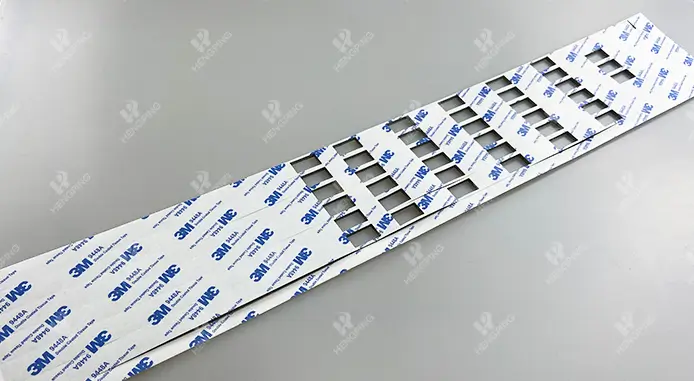
Firstly, material compatibility is very important. As we’ve discussed, some adhesives work better with certain materials. If you’re bonding a polycarbonate graphic overlay to a metal housing, you’ll need an adhesive that adheres well to both. Always check the datasheet provided by 3M, and see if it matches your materials. (Read more: Graphic Overlay Materials >>)
Secondly, think about the end-use environment. Will the product be used indoors in a controlled environment, or will it be exposed to harsh weather conditions? Will it come into contact with oils or cleaning agents? If so, you need to choose an adhesive that can handle the conditions it will be exposed to. Also, think about any extreme temperatures that the product may have to endure.
Lastly, performance requirements are another key consideration. Do you need a high-tack adhesive for quick assembly, or a high-strength adhesive for demanding applications? Are you looking for a thinner tape for a low-profile bond, or something a bit thicker to fill any gaps? Consider all of these elements, and you should be able to find a suitable adhesive for your applications.
In summary, ask yourself the following:
- What materials am I bonding? (overlay and substrate)
- What environment will the product be used in? (temperature, humidity, chemicals)
- What specific performance requirements do I need? (bond strength, flexibility, lifespan)
- Is quick assembly a requirement? Or is bond strength more important?
- Do you need UV resistance for outdoor use?
- Is thickness important? Do you need a thick or thin tape?
- Are there any specific compliance requirements? (RoHS, FDA, etc.)
How to Correctly Apply Adhesive to Graphic Overlays?
Even the best adhesive tape will fail if it’s not applied correctly. Here’s a step-by-step guide to ensure successful application:
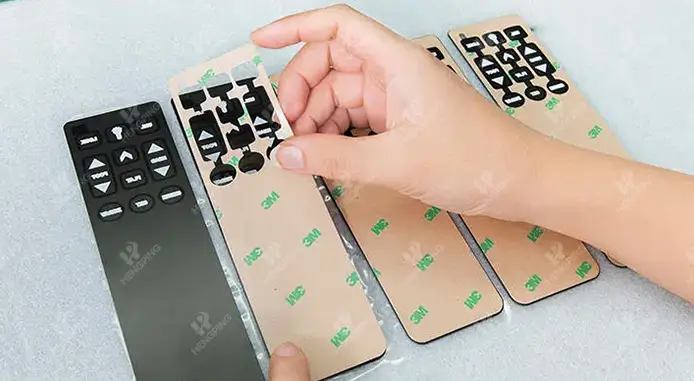
- Surface Preparation: The first step is to clean the bonding surfaces thoroughly. Remove all dust, grease, oils, and other contaminants using a suitable cleaning solvent, such as isopropyl alcohol. Allow the surfaces to dry completely before proceeding, a damp surface is bad for all adhesives.
- Alignment: Carefully align the graphic overlay with the target area. Use jigs, guides, or light tack tape to position the overlay precisely. This is key to avoiding any issues with alignment later on.
- Adhesive Application: Start by removing a small section of the adhesive’s release liner. Then, using a squeegee or a rubber roller, apply even pressure to the overlay, working from one edge to the other. This helps to squeeze out any trapped air and ensures a consistent bond. Be sure to go slowly, do not rush this step.
- Complete the Application: Once the entire overlay is applied, go over it again with the squeegee or roller to ensure there are no air bubbles, and the adhesive has properly bonded to the surface.
- Post-Application Pressure: After application, it may be necessary to apply pressure to the overlay for a set period. This is known as dwell time, and specific instructions for dwell time can be found on the datasheet for your chosen adhesive.
Automatic VS. Manual Adhesive Applying
Graphic overlay manufacturers typically use two methods for applying adhesive backing: manual and automatic. Here’s a simplified overview of when to use automatic vs. manual adhesive backing for graphic overlays:
- Manual Application: Ideal for small batches, prototypes, unique designs, cost-sensitive projects, and specialty adhesives.
- Automatic Application: Best for large quantities, consistent quality, complex shapes, and integration into automated production.
What Problems Could Occur and How to Avoid Them?
Despite the best efforts, problems can sometimes arise when applying adhesives. Here’s a look at some typical issues and how to avoid them:
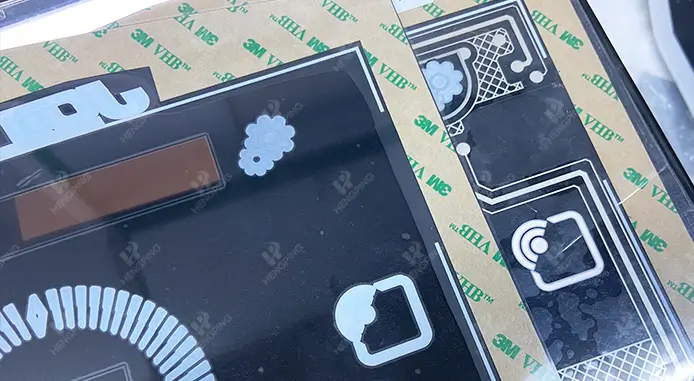
- Peeling or Lifting Edges: This is often a result of inadequate surface preparation, incompatible adhesives, or insufficient pressure during application. Always ensure that your surface is thoroughly cleaned and dried.
- Air Bubbles: These unsightly blemishes are caused by improper application techniques. Make sure you take your time and use even pressure from one edge to another, to squeeze out any trapped air.
- Poor Adhesion: If the tape is failing to bond properly, it is likely due to the wrong adhesive being chosen for the job, or due to the tape being expired, or being stored incorrectly. Be sure to refer to the data sheet and ensure your tape meets the specific needs of your application.
- Adhesive Residue: This can occur if the adhesive hasn’t fully cured or if the wrong tape is being used, check your datasheet for the best application information, and that the adhesive is in date.
- Counterfeit Tapes: The market is unfortunately rife with counterfeit tapes. Always purchase your 3M adhesives from an authorized and reputable supplier, to avoid any problems. Look for the correct 3M branding and markings on the product.
Conclusion
The choice of adhesive backing is paramount to the success of any graphic overlay project, and 3M provides a vast range of premium-quality options to meet diverse needs. As a leading graphic overlay manufacturer, Hengping Industry leverages expertises to deliver tailored adhesive solutions, carefully balancing budget considerations with required functionality, using only the most reliable 3M tapes. We guarantee all our 3M tapes are authentic and authorized, ensuring consistent performance and long-lasting bonds. Should you have questions or need guidance in selecting the right adhesive for your graphic overlays, please do not hesitate to contact us directly.

 English
  French
  German
  Spanish
  Portuguese
  Italian
  Dutch
Dutch  Turkish
  Russian
  Arabic
  Japanese
  Korean
  Vietnamese
  Thai
Thai  Indonesian