 Skip to main content Skip to footer
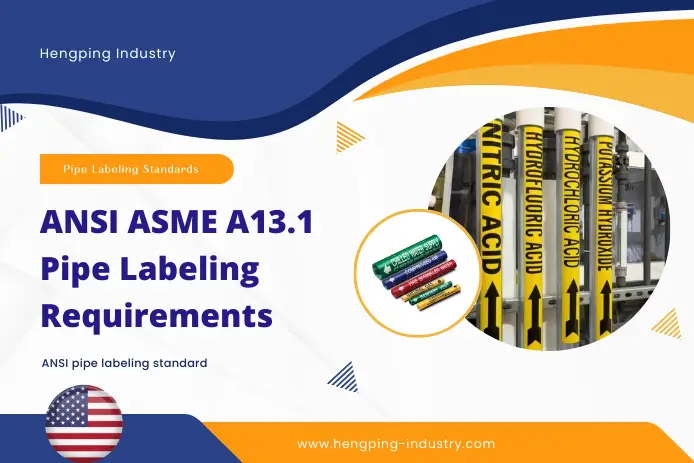
Industrial facilities, like chemical industry, manufacturing industry, and other commercial and industrial factories, are intricate webs of pipes carrying everything from harmless water to hazardous chemicals. Imagine the chaos if there were no clear way to identify these crucial lifelines! That’s where ANSI/ASME A13.1 comes in, providing a much-needed roadmap for pipe marking. This standard isn’t just about slapping on a label, it’s a comprehensive system designed to prevent accidents, streamline maintenance, and ensure a safe working environment.
ANSI/ASME A13.1 specifies requirements for identifying piping systems in the US and Canada, using color codes, labels, and markings to indicate contents, pressure, temperature, and hazards, ensuring worker safety and operational efficiency.

Looking to understand ANSI/ASME A13.1 pipe labeling requirements? This guide provides a comprehensive overview, covering color codes, sizing requirements, and practical applications to help you master pipe labeling best practices.
What is ANSI and ASME A13.1 Standard for Pipe Marking?
The ANSI/ASME A13.1 standard, officially titled “Scheme for the Identification of Piping Systems,” provides a standardized method for marking pipes in industrial facilities. It isn’t just about labeling—it encompasses a comprehensive system using color codes, markings (like stripes and bands), and labels to clearly identify pipe contents and potential hazards.
ANSI (American National Standards Institute) accredits the standard, while ASME (American Society of Mechanical Engineers) develops and maintains it. The goal is to enhance safety, prevent accidents, and improve efficiency by providing a universally understood visual language for piping systems.
History and Updates of ASME A13.1 Pipe Labeling
ASME A13.1, first introduced in 1953, provides standardized guidelines for the identification of pipe systems. Its goal was to create uniformity in marking pipes, especially in industrial environments, so that workers could easily identify the contents and hazards of piping systems. Over time, the standard has been updated to improve safety and reflect new industry practices.
- Early Development (Pre-1950s): The need for standardized pipe marking likely emerged alongside the increasing complexity of industrial facilities in the early to mid-20th century. Various industries and companies may have developed their own internal systems, leading to inconsistencies and potential safety hazards.
- First Editions (1950s-1970s): The earliest documented editions of ASME A13.1 likely appeared during this period, formalizing a standardized approach to pipe marking. These early versions established the basic principles of color coding and labeling.
- Subsequent Revisions (1980s-Present): ASME A13.1 has undergone several revisions over the years to address evolving industry needs, incorporate new materials and processes, and align with other safety standards. Key revisions and updates often include refinements to color codes, labeling requirements, and the introduction of new hazard symbols.
- Current Version: The current and most up-to-date version is ANSI/ASME A13.1-2015. It’s important to consult the latest version to ensure compliance with the most current recommendations.
What are the ASME A13.1 Pipe Label Requirements?
ASME A13.1 provides a comprehensive framework for effective pipe marking in industrial facilities. By understanding and implementing its requirements for color coding, labeling, markings, and addressing special considerations, businesses can significantly enhance safety, improve efficiency, and ensure regulatory compliance. It is always right to consult the latest edition of ASME A13.1 and seek expert advice when necessary to develop a pipe marking system tailored to your specific needs and regulatory environment.
ASME A13.1 Foundation: Color Coding
Imagine walking into a complex industrial facility and instantly understanding the contents of each pipe simply by its color. That’s the power of color coding as defined in A13.1. It provides a rapid visual cue for identifying the general nature of pipe contents, significantly enhancing safety and efficiency.
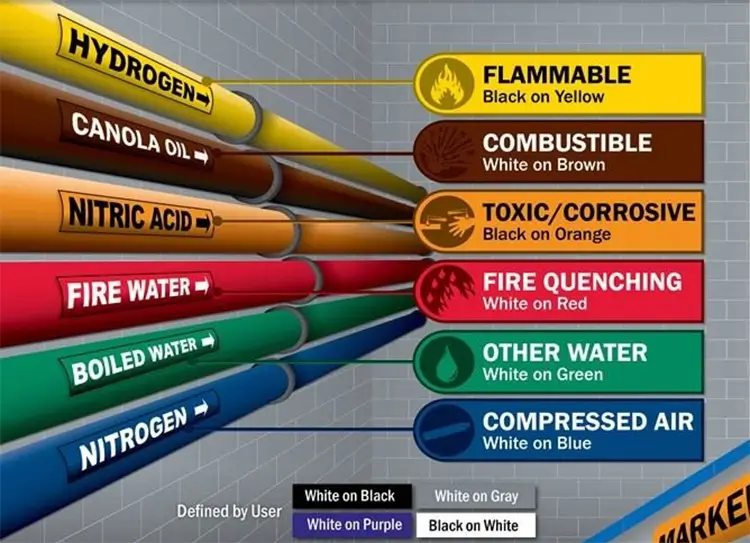
ASME A13.1 recommends specific colors for various categories of fluids and hazards:
| Color | General Contents | Specific Examples | Flexibility and Additional Markings |
| Red | Fire Quenching Materials | Water (for fire suppression), Foam, Other fire extinguishing agents | Can include additional markings for specific agents (e.g., “CO2” for carbon dioxide systems). |
| Yellow | Flammable Materials | Gasoline, Propane, Natural gas, Acetylene, Other flammable gases and liquids | Can be further differentiated with markings for specific flammability hazards (e.g., flash point). |
| Orange | Toxic or Corrosive Materials | Acids, Bases, Chlorine, Ammonia, Other toxic or corrosive gases and liquids | Can use additional markings to specify the degree of toxicity or corrosivity. |
| Green | Safe Materials | Potable water, Compressed air (for general use), Nitrogen (inert), Other non-hazardous materials | Can use markings to differentiate between different safe materials if needed. |
| Blue | Protective Materials | Gases or liquids used for protective atmospheres (e.g., nitrogen blanketing), Other protective substances | Can include markings to specify the protective function. |
| Purple | Dangerous When Wet Materials | Sodium, Calcium carbide, Other substances that react dangerously with water | Often includes supplementary warning labels emphasizing the danger of water contact. |
| Brown | Combustible Liquids | Fuel oil, Diesel, Kerosene, Other combustible liquids (typically with higher flash points than flammable liquids) | Can be further differentiated with markings for specific properties or hazards. |
| Gray | Other Materials | Substances not readily categorized within the other colors, Often used for general utility services or materials with low hazard | Can be combined with other colors or markings to provide more specific identification. |

Important Notes on A13.1 Color Coding
- Recommendations, Not Requirements: These are recommended color codes, not strict mandates. Deviation is allowed if a consistent and well-documented alternative system is implemented.
- Context Matters: The specific context and potential hazards should always be prioritized. For instance, even though yellow is the general color for flammables, a specific hazard color like red might be used if the material poses an immediate fire hazard.
- Consistency is Key: Whatever color code system is used, it must be applied consistently throughout the facility to avoid confusion.
- Supplementary Labeling is Essential: Color coding provides a quick visual cue, but it must always be accompanied by detailed labels providing specific information about the pipe contents and hazards.
- Consider Other Regulations: While A13.1 provides guidance, other regulations (e.g., OSHA’s Hazard Communication Standard) might impose additional requirements.
ASME A13.1 Labeling Requirements
Color coding provides a quick overview, but labels add the crucial specifics. ASME A13.1 dictates precise information that should be included on pipe labels:
- Substance Name: Use the full chemical name or a readily understood common name. Avoid ambiguous abbreviations or jargon. For added clarity, include the chemical formula, especially for less common substances.
- Hazard Warnings: This goes beyond simply stating the contents. Labels must clearly communicate potential hazards associated with the substance using appropriate hazard pictograms and signal words (Danger, Warning, Caution) conforming to the Globally Harmonized System (GHS).
- Flow Direction: An arrow must clearly indicate the direction of flow within the pipe. This is crucial for understanding system dynamics and responding effectively in emergencies.
Beyond content, A13.1 addresses practical considerations for label design and placement:
- Legibility: Labels must be easily readable from a safe distance. Use appropriate font sizes, contrasting colors, and clear, concise language.
- Durability: The label material must withstand the environment’s challenges, including temperature extremes, chemical exposure, moisture, and UV radiation. Choose durable materials like high-performance vinyl, polyester, or even metal for harsh conditions.
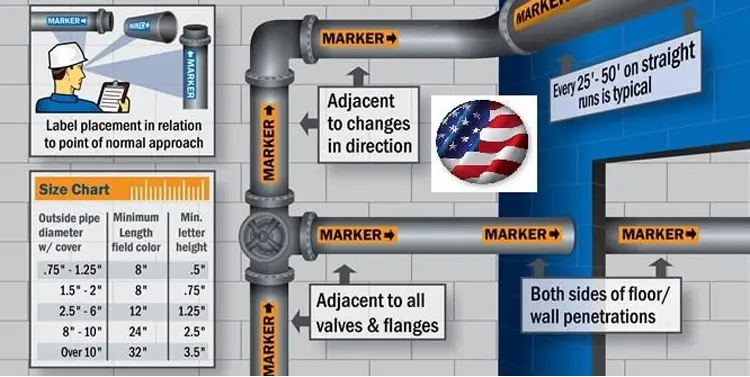
- Placement: Labels should be strategically placed for optimal visibility, particularly near valves, flanges, and other critical points. Avoid placing labels where they might be obstructed or easily damaged.
ASME A13.1 Markings Supplementary Information
In addition to color coding and labeling, A13.1 recognizes the value of supplementary markings. These markings, such as stripes, bands, or other visual cues, provide additional layers of information beyond the basic content of the label. For instance, markings can differentiate between different branches of a piping system, indicate specific hazards within a broader category, or provide other relevant information.
ASME A13.1 Special Considerations
ASME A13.1 provides specific guidance for handling unique or challenging pipe marking situations:
- Small-Bore Piping: Labeling small-diameter pipes can be tricky due to limited space. The standard offers recommendations for using smaller labels, abbreviated text, or alternative identification methods.
- Insulated Pipes: Labels applied directly to insulated pipes might not be visible. A13.1 suggests solutions like applying labels over insulation jacketing or using tag systems.
ASME A13.1 Compliance
While ASME A13.1 itself is not a legally mandated regulation, adhering to its recommendations is crucial for complying with broader safety regulations, such as OSHA’s Hazard Communication Standard (HCS). These regulations mandate clear hazard communication in the workplace, and a robust pipe labeling system based on A13.1 principles plays a key role in achieving compliance.
7 Steps to Find ANSI/ASME A13.1 Compliant Pipe Label Suppliers
Finding suppliers or manufacturers of ANSI/ASME A13.1 compliant pipe labels requires a targeted approach.

- Targeted Online Searches: Use specific keywords like “ANSI/ASME A13.1 pipe labels,” “A13.1 compliant pipe markers,” or “ANSI pipe identification” to find relevant suppliers.
- Industry Directories: Consult directories specializing in safety products, industrial supplies, or labeling solutions. Look for listings that explicitly mention ANSI/ASME A13.1 compliance.
- Manufacturer Websites: Many major label manufacturers, such as Brady Corporation and 3M, have dedicated sections on their websites for pipe marking solutions. Check if they offer A13.1 compliant products.
- Trade Shows and Conferences: Attend industry trade shows and conferences related to safety, facility management, or industrial processing. These events provide opportunities to meet suppliers directly and discuss your needs.
- Networking and Referrals: Ask colleagues, industry professionals, or other businesses for recommendations on reputable pipe label suppliers.
- Requesting Quotes and Samples: Contact potential suppliers, provide details about your specific requirements (pipe sizes, materials, chemical contents), and request quotes and samples. This allows you to compare pricing, materials, and printing quality.
Key Questions to Ask Potential Suppliers:

- Do your pipe labels fully comply with ANSI/ASME A13.1?
- What materials and adhesives do you offer for different pipe substrates and environments?
- Can you provide custom pipe labels to meet our specific requirements?
- What printing technologies do you use to ensure label durability and legibility?
- What are your lead times and minimum order quantities?
- Can you provide references or testimonials from other clients?
By following these steps and asking the right questions, you can identify a reliable supplier that provides high-quality, ANSI/ASME A13.1 compliant pipe labels to meet your specific needs and enhance workplace safety. Don’t hesitate to request certifications or documentation to verify compliance.
Conclusion
Though originating in the US and Canada, ANSI/ASME A13.1 is a globally influential pipe identification standard. Its clear, logical system, prioritizing safety and communication, is widely adopted and informs other international schemes, even where not mandated. Efforts continue to harmonize A13.1 with other global standards. Therefore, understanding ANSI/ASME A13.1 pipe labeling standards is specially important for people who are in pipe labeling industry or real industrial workshops.



 English
  French
  German
  Spanish
  Portuguese
  Italian
  Dutch
Dutch  Turkish
  Russian
  Arabic
  Japanese
  Korean
  Vietnamese
  Thai
Thai  Indonesian