

What is OSHA and Its Role in Workplace Safety?
The Occupational Safety and Health Administration (OSHA) is a federal agency responsible for ensuring safe and healthful working conditions for workers in the United States. OSHA sets and enforces standards, and provides training, outreach, education and assistance. One critical aspect of workplace safety, particularly in industries involving chemicals, manufacturing and utilities, is the proper labeling of pipes. Pipes carrying various substances, some hazardous, crisscross many facilities. Without clear and consistent labeling, employees are at risk of accidental exposure, leaks, spills, and other potentially catastrophic incidents.
Why is Pipe Labeling Important?
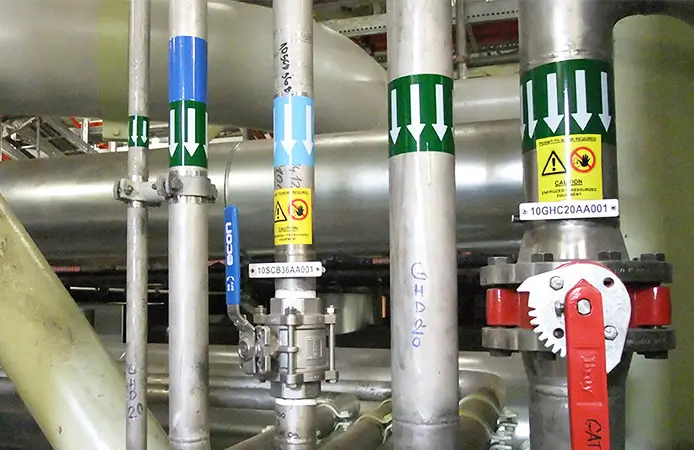
Effective pipe labeling is crucial for several reasons:
- Worker Safety: Clear labels identify the contents of pipes, allowing workers to take appropriate precautions.
- Emergency Response: In the event of a leak or spill, properly labeled pipes help emergency responders quickly identify the hazards and take appropriate action.
- Maintenance and Repair: Accurate labeling assists maintenance personnel in identifying the correct pipes for maintenance or repair work, preventing accidental releases or damage.
- Compliance: OSHA mandates specific pipe labeling requirements, and failure to comply can result in hefty fines and penalties.
OSHA’s Pipe Labeling Standards
OSHA doesn’t have a single, self-contained standard dedicated solely to pipe marking. Instead, it references and incorporates industry consensus standards, primarily the American National Standards Institute/American Society of Mechanical Engineers (ANSI/ASME) standard A13.1, “Scheme for the Identification of Piping Systems.” Additionally, the Globally Harmonized System (GHS) for the classification and labeling of chemicals influences pipe labeling requirements, as does OSHA’s Hazard Communication Standard (29 CFR 1910.1200).
OSHA’s Primary Pipe Labeling Standard: ANSI/ASME A13.1
While OSHA doesn’t explicitly detail every requirement for pipe marking within its own regulations (29 CFR), it incorporates the ANSI/ASME A13.1 standard by reference. This means that compliance with ANSI/ASME A13.1 is often considered compliance with OSHA’s expectations.
The ANSI/ASME A13.1 standard provides a comprehensive scheme for identifying piping system contents. Key elements of this standard include:
Color Coding Requirements
The standard recommends specific colors for different categories of pipe contents:
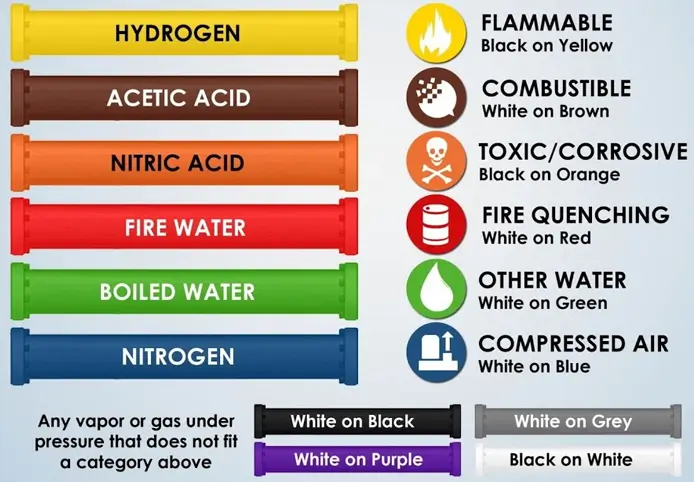
- Fire Protection: Red background with white lettering.
- Dangerous Materials: Yellow background with black lettering.
- Safe Materials: Green background with white lettering.
- Protective Materials: Blue background with white lettering.
- Flammable Materials: Orange background with black lettering.
- Combustible Materials: Brown background with white lettering.
- Other specific colors can be used for particular materials or categories as defined by the facility. It’s crucial to maintain consistency throughout the facility.
Label Size and Placement
Labels should be easily visible and legible from a normal point of approach. The size of the label and text should be appropriate for the diameter of the pipe and the viewing distance. General recommendations include:
- Labels should be placed near valves, flanges, changes in direction, and where pipes pass through walls or floors.
- Labels should be positioned so they can be read from the normal operating position.
- The spacing between labels should be such that any part of the piping system is readily identifiable. A general guideline is that labels should be visible every 25-50 feet on straight runs.
Required Information
Labels should clearly identify the contents of the pipe and the direction of flow. Essential information includes:
- Contents: The name of the substance carried by the pipe (e.g., “Hot Water,” “Compressed Air,” “Sulfuric Acid”). Chemical names should be used rather than abbreviations or formulas when clarity is essential.
- Direction of Flow: An arrow or other indicator should show the direction in which the substance flows through the pipe.
- Additional information, such as pressure, temperature, or specific hazards, may be included as needed.
Specific Requirements for Hazardous Materials
When pipes carry hazardous materials, additional labeling requirements apply. These may include:
- The name of the hazardous substance.
- Appropriate hazard warnings (e.g., “Flammable,” “Corrosive,” “Toxic”).
- Specific handling precautions.
- Reference to the Safety Data Sheet (SDS) for the substance.
- GHS pictograms when applicable (discussed in the next section).
GHS and its Impact on Pipe Labeling

The Globally Harmonized System (GHS) is an internationally recognized system for classifying and labeling chemicals. OSHA has incorporated GHS into its Hazard Communication Standard (29 CFR 1910.1200), which requires employers to provide information to employees about the hazardous chemicals they work with.
GHS significantly impacts pipe labeling by standardizing the way hazards are communicated. Key elements of GHS labeling that apply to pipes include:
- Pictograms: GHS uses standardized pictograms (symbols within a red diamond) to visually represent different types of hazards (e.g., flame for flammable, skull and crossbones for toxic). Pipes carrying GHS-classified hazardous substances should display the appropriate pictograms.
- Signal Words: GHS uses signal words to indicate the severity of a hazard: “Danger” for more severe hazards and “Warning” for less severe hazards. The appropriate signal word should be included on pipe labels for hazardous materials.
- Hazard Statements: GHS hazard statements are standardized phrases that describe the nature of a hazard (e.g., “Flammable liquid and vapor,” “Causes serious eye damage”). Relevant hazard statements should be included on pipe labels.
The integration of GHS into pipe labeling ensures consistency and makes it easier for workers to understand the hazards associated with different pipe contents, regardless of where they work or the origin of the chemicals.
Other Relevant OSHA Standards and Guidelines
While ANSI/ASME A13.1 and GHS are central to OSHA’s pipe labeling requirements, other standards and guidelines may also apply, depending on the specific industry or materials involved. These include:
- 29 CFR 1910.1200 (Hazard Communication Standard): This standard requires employers to identify and evaluate chemical hazards in the workplace and to provide training to employees on how to work safely with those hazards. It mandates the use of labels and safety data sheets (SDS) to communicate hazard information, which directly impacts how pipes containing hazardous chemicals must be labeled.
- 29 CFR 1910.147 (Lockout/Tagout Standard): While not directly about labeling, this standard requires procedures for controlling hazardous energy sources, including the contents of pipes. Proper pipe identification is essential for safe lockout/tagout procedures, ensuring that the correct pipes are isolated and de-energized before maintenance or repair work is performed. Clear labeling prevents accidental release of energy during these operations.
- Industry-Specific Standards: Some industries have specific OSHA standards or guidelines that address pipe labeling in more detail. For example, the maritime industry (shipyards, marine terminals) has specific requirements related to the labeling of piping systems on vessels and in port facilities. Similarly, the construction and process safety management (PSM) industries have specific guidelines related to process piping.
- State and Local Regulations: Some states and local jurisdictions may have their own pipe labeling regulations that are more stringent than federal OSHA requirements. It’s important to be aware of any state or local regulations that may apply.
Best Practices for Effective Pipe Labeling

Beyond simply meeting the minimum requirements of OSHA and relevant standards, implementing best practices can significantly enhance the effectiveness of a pipe labeling system. These practices include:
- Durability and Legibility: Labels should be made of durable materials that can withstand the environment in which they are used. This includes resistance to temperature extremes, moisture, chemicals, and abrasion. The label and text color should contrast with the pipe’s color to ensure readability. Consider using UV-resistant materials for outdoor pipes.
- Training Employees: All employees who work with or around pipes should be thoroughly trained on the pipe labeling system used in the facility. This includes understanding the color codes, symbols, and other information on the labels, as well as the procedures for updating and maintaining labels. Refresher training should be conducted periodically.
- Regular Inspections and Maintenance: Labels should be inspected regularly to ensure they are still legible and in good condition. Damaged or missing labels should be replaced immediately. A formal inspection program, with documented checks, is crucial. Include pipe labeling checks in routine safety audits.
- Consistent Labeling System: Using a consistent labeling system throughout the facility is essential for avoiding confusion and errors. This means using the same color codes, label formats, and abbreviations on all pipes. If multiple facilities exist within an organization, striving for consistency across all locations is highly beneficial.
- Special Considerations for Unique Environments: Some environments may require special labeling considerations. For example, in areas with extreme temperatures, labels should be made of materials that can withstand those temperatures. In corrosive environments, labels should be made of corrosion-resistant materials. For insulated pipes, ensure labels are visible on the outer surface of the insulation or on tags attached to valve handles.
- Use of Technology: Consider using technology such as barcode labels or RFID tags to improve the accuracy and efficiency of pipe labeling. These technologies can be used to track pipe contents, maintenance history, and other important information. They can also facilitate easier updating and management of labeling systems.
- Photographic Documentation: Maintaining a photographic record of properly labeled piping systems can be invaluable during inspections, audits, and incident investigations.
- Pipe Labeling Software: Utilizing pipe labeling software can aid in the design and printing of consistent, compliant labels. Many programs offer templates, symbol libraries, and data management features.
Exemptions and Special Cases
While comprehensive pipe labeling is the goal, there are some limited situations where OSHA might grant exemptions or where alternative methods may be acceptable. These situations are typically based on practicality and the presence of other safeguards:
- Short Pipe Segments: Very short pipe segments, such as those connecting two pieces of equipment within a small area, may not require labeling if the contents are obvious and the hazards are well understood by the workers in that area. However, this is a judgment call, and it’s always safer to err on the side of caution and label the pipe.
- Clearly Understood Contents: In some situations, where the contents of a pipe are universally known and understood by all personnel in the area, and where the contents pose no significant hazard, labeling might not be strictly required. An example might be a clearly marked, dedicated water line in a non-industrial setting. However, this is a rare exception, and again, labeling is always recommended.
- Alternative Labeling Methods: In certain situations, OSHA might allow alternative labeling methods if they provide an equivalent level of safety and hazard communication. For example, if a pipe is too small or too difficult to access for traditional labeling, a nearby sign or placard might be acceptable, provided it clearly identifies the pipe and its contents. Color-coding alone is rarely sufficient; it needs to be supplemented with written information.
- Temporary Piping: Piping used temporarily for short-term projects may have less stringent labeling requirements, but it must still be adequately identified to prevent accidents. The degree to which “less stringent” applies depends on the hazard level and how “temporary” is defined in time.
It’s crucial to remember that exemptions are rare and must be carefully justified. If there is any doubt about whether a pipe needs to be labeled, it’s always best to err on the side of safety and provide clear and comprehensive labeling. Documenting the justification for any exemptions is also critical.
Enforcement and Penalties for Non-Compliance
OSHA enforces its standards through inspections, investigations, and citations. If an OSHA inspection reveals violations of pipe labeling requirements, the employer may face significant penalties.
- Inspection Procedures: OSHA inspections may be conducted unannounced or may be scheduled in response to a complaint or incident. Inspectors will review the facility’s pipe labeling system, interview employees, and examine records to determine compliance with OSHA standards.
- Potential Fines and Penalties: Penalties for violating OSHA standards, including pipe labeling requirements, can be substantial. Fines vary depending on the severity of the violation and the employer’s history of previous violations. Penalties can range from several thousand dollars to hundreds of thousands of dollars for willful or repeated violations. Fines are adjusted periodically for inflation. Beyond monetary penalties, violations can lead to reputational damage and increased scrutiny from regulatory agencies. Criminal charges are possible in cases of willful negligence leading to serious injury or death.
- Importance of Maintaining Proper Documentation: Maintaining accurate records of pipe labeling procedures, training, inspections, and any corrective actions taken is crucial for demonstrating compliance with OSHA standards. Documentation can be invaluable during an OSHA inspection and can help to mitigate potential penalties in the event of a violation. Records should be readily accessible and well-organized. Include photographic records of labeled pipes where feasible.
Steps for Implementing an OSHA-Compliant Pipe Labeling System
Implementing a new or updating an existing pipe labeling system requires a systematic approach. Here are key steps to ensure compliance with OSHA requirements:

- Conduct a Thorough Assessment: Begin by conducting a comprehensive assessment of all piping systems in the facility. Identify all pipes that require labeling, the contents of each pipe, and any potential hazards associated with those contents. Document existing labeling practices and identify any deficiencies. Involve maintenance, engineering, safety, and operations personnel.
- Develop a Labeling Plan: Based on the assessment, develop a detailed labeling plan that specifies the color codes, label formats, required information, and placement of labels. This plan should align with ANSI/ASME A13.1, GHS, and any other applicable OSHA standards or industry guidelines. Decide on a format for additional information such as temperature, pressure, or special hazard warnings.
- Select Appropriate Labels: Choose durable labels that are appropriate for the environment in which they will be used. Consider factors such as temperature, moisture, chemical exposure, and abrasion resistance. Ensure labels meet any specific industry standards or regulatory requirements.
- Prepare the Piping Surfaces: Ensure the surfaces of the pipes are clean and dry before applying labels. This might involve removing rust, dirt, or old labels. For insulated pipes, determine the best method for label attachment (e.g., tags, adhesive labels on the outer jacket).
- Create and Apply Labels: Generate labels using a consistent format and language. Ensure all required information is included and that the labels are legible. Apply labels securely to the pipes in the designated locations according to the labeling plan. Use a labeling machine or pre-printed labels for consistency and durability.
- Train Employees: Provide comprehensive training to all employees who work with or around pipes. The training should cover the pipe labeling system, color codes, symbols, hazard information, and emergency procedures. Document the training, including attendance and the topics covered. Conduct refresher training periodically.
- Implement a System for Ongoing Maintenance and Updates: Establish a system for regular inspections of labels to ensure they are still legible and in good condition. Develop procedures for replacing damaged or missing labels promptly. Update the labeling system as needed when new pipes are installed or when the contents of existing pipes change. Assign responsibility for maintaining the labeling system to specific individuals or departments.
- Conduct Regular Audits: Periodically conduct audits of the pipe labeling system to ensure it remains effective and compliant. Document audit findings and corrective actions taken.
- Maintain Accurate Records: Keep detailed records of all aspects of the pipe labeling system, including the initial assessment, labeling plan, label specifications, employee training, inspections, maintenance activities, and any corrective actions taken.
Conclusion
OSHA’s pipe labeling requirements, primarily through the incorporation of ANSI/ASME A13.1 and the influence of GHS, are critical for ensuring workplace safety. Effective pipe labeling prevents accidents, protects workers from hazardous exposures, facilitates emergency response, and aids in maintenance and repair operations. Pipe markers that comply with these requirements are essential for workplace safety, and finding a reliable pipe marking label manufacturer can ensure your facility meets OSHA standards, reduces the risk of accidents and injuries, improves operational efficiency, and demonstrates a commitment to a safe and compliant work environment.



 English
 French
 German
 Spanish
 Portuguese
 Italian
 Dutch
 Turkish
 Russian
 Arabic
 Japanese
 Korean
 Vietnamese
 Thai
 Indonesian