

Introduction of Industrial Pipeline Labels
Industrial pipeline labels are used to identify substances in industrial pipelines to ensure safe production and avoid misjudgment in operation and equipment maintenance. Visualization of the pipeline can predict the name of the fluid in the pipeline, predict the danger of the pipeline, prevent misoperation, mistakenly touching the equipment, prevent accidents, and improve the efficiency of pipeline operation and maintenance.

Whether industrial pipe labels are sticked well or not has a direct impact on the safety and efficiency of pipeline operation work. This blog introduces considerations of pipe labelling process and helps operator to sticker a safe and beautiful industrial pipe marking labels.
Industrial Pipe Marking Label Standards
If you don’t know anything about industrial pipe labeling, you will definitely feel clueless about its labelling work. Actually, the best and simple way to get familiar with industrial pipe label standards.
International Industrial Pipe Marking Label Standards
Every country or region has its own standards for industrial pipe marking labels, some can be used widely, some are not. Here list some of industrial pipe marking label standards.
- USA: The ANSI/ASME A13.1-2007 standard is the main standard used in the USA, as well as some industry-specific standards, such as API standards.
- Europe: European countries typically use EN ISO 14726:2004.
- Japan: Japan has its own pipe marking standard, called JIS B 8275.
- China: China mainly adopts GB 7231-2003 “Basic identification colors, identification symbols and safety marking of industrial pipelines”.
Highlights of Industrial Pipe Label Standards
There are three key points in understanding the standard of industrial pipe labels:
Provisions for Different Marking Colors for Different Media (Mandatory Provisions)
Identify which pipes need to be labeled and what the medium inside is, and determine the color based on corresponding standards. If the industrial pipe labels are purchased from a professional pipe label manufacturer, then you only need to confirm the color since the supplier will help you choose the correct color.

If the pipe labels are simply made by an advertising company, then you are responsible for the accuracy of the label color and ensuring that it meets the relevant standards.
Marking methods
Choose the marking method. Different standards have different marking methods. The following are the marking methods in China:
- Marking on the entire length of the pipe
- Marking on the pipe with a 150mm wide color ring
- Marking of the pipeline with a rectangular identification color plate
- Marking of the pipeline with a rectangular identification color plate with arrows.
- Marking of the pipeline with a tethered identification color plate
Marking position
In most of the standards, pipes should be labeled at the beginning, end, intersections, turns, valves, and on both sides of the hole through the wall. However, this is not mandatory, and piping labels are applied according to their actual situation.
For example, there are two consecutive turns, there is no need to label each turn. After the pipe through the wall there is a turn, here labeling or not should also be considered according to the actual situation. Labeling should be positioned so that confusing places are clear, not blindly following a standardized mess of labeling. It is not the case that the more labels you put up, the better.
Industrial Pipe Marking Labels Applying Tips and Steps
The labelling of Industrial pipe marking labels seems simple, but contains a number of steps. Every step should be paid attention to ensure final labelling work. Here are five steps for industrial pipe marking labelling.
Purchasing Industrial Pipe Labels
Before applying the industrial pipe labels, the most important step is to purchase the required industrial pipe labels with premium quality.
Materials for Industrial Pipeline Labels
When buying industrial pipe labels, make sure to choose a good material, generally waterproof, acid and alkali resistant, high temperature resistant, sticky, reflective material is great for industrial pipe labels.
Most pipe label suppliers offer industrial pipe labels made of materials with these characteristics, but it is still important to check with the supplier to confirm that their labels meet the requirements of the application scenario based on the specific use environment.
Quantity of Needed Industrial Pipe Labels
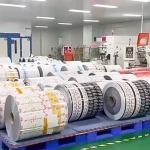
There should be a detailed count of the pipes planned to be labeled, including name, diameter, and quantity. Generally, industrial pipe labels are sold in rolls (about 27M/R).
You can calculate how many rolls are needed based on the quantity of labels and the diameter of the pipe. Don’t forget to buy a few extra sheets to avoid mistakes in labelling, resulting in insufficient quantity.
Industrial Pipe Label Designs
After the quantity is determined, the label design is followed up. Because the pipeline medium of each factory is different, the purpose of the label is different, the text on the label should be customized.

If there is no idea of the font size, you can print out different font sizes on A4 paper for a visual check, generally keep within 1-2m can be seen on it. Recommended font is bold or Arial.
Industrial Pipeline Marking Label Size
Regarding the size, 50*250 label for 100mm pipe diameter looks quite harmonious. But 25*125 for 50mm pipe diameter looks too small. How to balance this kind of disharmony still depends on the actual situation.
Receiving and Inspection for Industrial Pipe Labels
When you receive the customized industrial pipe labels, you need to check them carefully, including the quantity, type, and color. Ensure that the color of the label of the same medium can not differ from each other, the color of the label and the arrow can not differ from each other, as well as all the colors are not too different from the standard color.
Preparation Before Labeling
For outdoor industrial pipeline labeling, it is important to estimate how many days needed according to the number of spots. And it is better to choose consecutive sunny days for labelling work. If there are original labels, remember to set some time aside to clear up the original label.

Labeling can be done by yourself or by a contractor. If you do the labeling yourself, it takes time and effort, and there are a lot of things you need to pay attention to. Some industrial pipeline label manufacturers or suppliers will have engineers on site to guide. However, the involvement of multiple parties is prone to conflicts, communication and coordination is also more troublesome.
It is recommended to directly choose the labeling services of the labeling supplier, they generally have a professional construction team, can effectively resolve internal conflicts, and has a wealth of experience to ensure that the labeling quality to achieve the best results.
Labelling
After the preparation of labelling work, here comes to the most important step: Labelling. Here are also several steps when applying the industrial pipe labels.
Cleaning
- Be sure to clean the original sign thoroughly. Cleaning solvent is necessary, because the residual glue is very difficult to clean. If the traces of the original marking are not cleaned, it will affect the firmness of the new marking on the one hand, and on the other hand, it will not be aesthetically pleasing.
- Mark the pipeline during cleaning or before, so that you do not know what the pipeline medium and direction is after all the old markings are removed.
Labelling
- Before labeling, as the labels are usually in rolls, they need to be cut into segments according to the pipe diameter, which is time-consuming. If you want to save time, you can communicate with your industrial pipeline label supplier in advance and ask them to cut the labels according to the requirements before shipment.
- The order of applying industrial pipe labels is also strategic and should follow the arrangement of the pipelines. If it is a single pipe, it is posted from the beginning to the end. If it is a lot of pipes in side by side distribution, although it is also from the beginning to the end, but the key is to all side-by-side pipes at the same time from the beginning to the end. Because the side-by-side pipeline labeling, must be in the same point of alignment, otherwise it will bring a very cluttered feeling.

- Then comes the determination of the point of position, according to the standard, it should be applied at the starting point, the end point, the intersection, the turning point, both sides of the valve and the hole through the wall outside the labeling. But the actual situation is more complex, the distance between these points may be very close, if in accordance with this requirement to post, it is likely to appear in a certain area of the label density is very high. In this case, it not only fails to achieve the purpose of labeling, but will increase the difficulty of identification. So when labeling, there should be some trade-offs, focusing on the Key point at the labeling. For example, the position where the employee will operate directly near should be labeled, and the label can be a direct indication of the pipeline or valve medium and flow direction, there is no need for operators to carry out a second identification.
- The next step is to apply all the industrial pipe labels based on before preparation and plans.
Inspection After Completing Label Applying
The day when all the labelling work is finished, it is necessry to check all the signs from the beginning to the end of the project. After a period of completion, go back to the site and inspect the signs again to check for any quality problems or peeling edges caused by the labelling. If there are any, contact the label supplier to deal with it.
Conclusion
Hengping Industry is a professional label manufacturer and offers various customized pipe marking labels for industrial uses.

If you are now looking for a reliable industrial pipe marking label supplier, just contact us directly, we can provide samples for your testing and our engineers will offer you professional instruction about industrial pipe labels.



 English
  French
  German
  Spanish
  Portuguese
  Italian
  Dutch
Dutch  Turkish
  Russian
  Arabic
  Japanese
  Korean
  Vietnamese
  Thai
Thai  Indonesian